Archive for the ‘Craft’ Category

Collapsible Knitting Needle

Sunday, January 22nd, 2012

I needed a break. I’ve been working hard on the osPID for several months, and I just needed to not look at code or control algorithms for a little bit. Nothing says “break” like an out-of-left-field project.


I only started knitting recently. Something that’s been bothering me about it is the length of the needles. They’re 14″ long, and I’ve been worried they’ll be bent while riding in my backpack.

It occurred to me that some sort of collapsible needle might be useful in this situation. Taking my inspiration from elastic tent poles, I got to work on my “not PID” project.

construction


The first thing to do was cut the needles in half. I used a pipe cutter for a nice clean cut, then cleaned up the seam with a drill.


With the needles prepped, I then used a lathe to make the supporting inserts.


I didn’t quite get the diameter of the inserts right, so I touched things up at the sanding station.


To get some decent springiness, I looped 3 rubber bands together, then doubled that over. This was pulled through the insert and locked in place with a piece of paperclip. I then super-glued the insert into the pointed half of the needle.


The last thing to do was anchor the other end of the rubber bands in a hole drilled in the cap.

Results


I’m really happy with how these turned out. The weight increase was negligible, and the seam is almost invisible. It puts a slight drag on the yarn, but nothing major, and I haven’t had any hangs yet. Also, because the halves are connected, you can fold the needle with your knitting on it, without worrying that things are going to fall off.

flattr this!

When a Maker Gets Married

Monday, August 15th, 2011


I got married a couple of weeks ago. We did all the planning / decoration ourselves. By we, or course, I mean my wife. One of the things she wanted to do was have paper lanterns suspended above the tables.

The initial plan was to use throwies, but I felt they wouldn’t give as much light as a commercial 3 LED solution. This led me to a fun, albeit time consuming project.

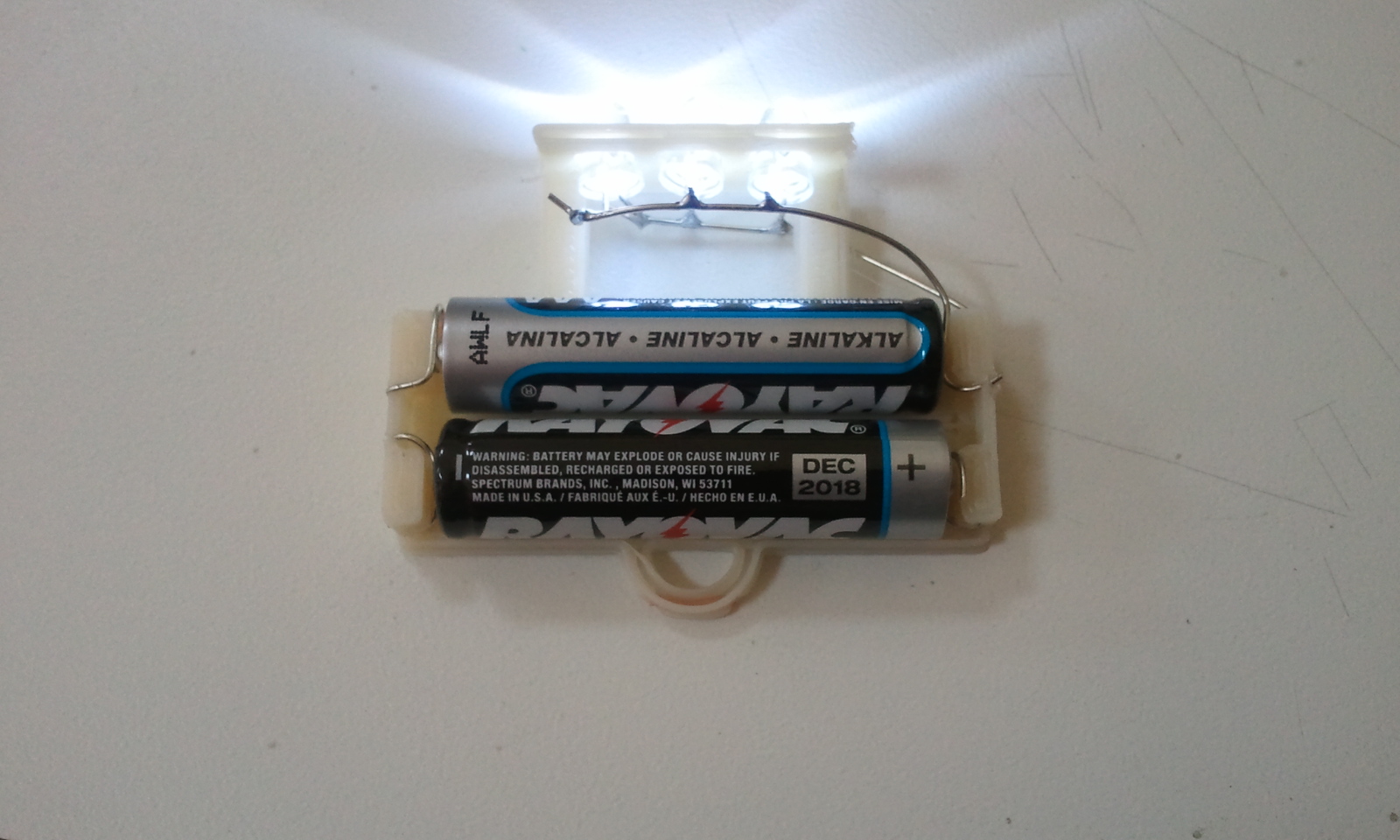
The commercial version boasts a 12 hour life, which probably means 6-8 hours at decent brightness. I was looking for something that we could set up the night before, so I settled on 3 LEDs powered by 2 AA batteries. (It turns out that this provided bright light for 3-4 days, with the LEDs still going after 1.5 weeks)

The Design

The over-arching design constraint was to have the lights held pretty high within the lantern. Initially I had thought they would be in the middle, but because LED light radiates out in a cone, having them higher leads to more of the lantern being lit.

constraint #2 came from the fact that I decided to 3D print the frame. Since I was making A lot of these (75) I needed to make them as quickly as possible. This meant a skeletal design using as little plastic as possible. Here’s what I came up with:

There’s just a bare minimum of plastic there. most of the structural integrity comes from the batteries themselves. By making the batteries parallel to the ground I was also able to get the lights a little higher than if they had been perpendicular.

Construction

Designing / printing of the frame was only the beginning. I was able to print 4 holders at a time on sprout’s thingomatic. During the 38 minute print, I would wire up the previously printed set. It took me a while to settle on an efficient assembly technique, but here’s what I wound up with (mouse over for description, click for larger image):


Since these were designed to be used only once, and they weren’t going to be moving around a lot, I was ok just melting loops of wire into the ABS frame. Springs and plates would have been more robust, but also more costly and time consuming.

Once the unit was assembled, I inserted the batteries using a piece of paper to break the circuit prior to installation. While not technically needed, I also secured the batteries with tape so they wouldn’t fall out during transport.


One design wrinkle I ran across during setup: the 3 LED configuration created weird hot-spots on the sides of the lanterns. A single-ply piece of kleenex taped over the lights acted as a diffuser. It slightly diminished the intensity of the light, but it provided that soft glow we were after.

Results

I think they turned out great. They produced the desired lighting effect, and I got many “wait… you did what?” responses. In the end it took me about 20min per unit. considering I made 75 of these it was a complete commercial flop. BUT it’s always fun to exercise the design muscles, and I was able to contribute something personal to our celebrations.

UPDATE: Part has been uploaded to Thingiverse

flattr this!

Sandal Retread using Fillet ‘o Tire

Sunday, August 2nd, 2009

Sandals After

I did this once years ago, and it worked really well. Take an old tire, and recycle it to make indestructible shoe soles. Tire tread is designed to handle way more abuse than simple walking can dish out. My current sandals were starting to wear down, and it was time to do it again.

There’s just one issue when using a tire: there’s a steel mesh embedded in the rubber. It rigidly holds a curved shape, which is not what you want. The solution I came up with was to fillet the tire, keeping the tread and leaving the steel behind. Good stuff.

Beyond that it’s a straight-forward process. You remove the old soles and glue the new ones on. The rest of my sandals will fall apart long before the soles do.

I took a bunch of pictures. Should make for a decent Instructable.

flattr this!

Holy Crap I Made Cheese

Thursday, July 2nd, 2009

done

That’s right. Cheese. I was surprised by how easy it was.  It was just a simple farmer’s cheese, but still.  Making cheese is one of those things you just assume is impossible; for professionals only.  Turns out people have been making it for a long time, with tools far cruder than what we have today.  Who knew?

This could probably be an Instructable, but I’m not an expert, and I’d hate to inadvertently lead someone astray.  This is what worked for me, your results may vary.

So let’s get down to it.  I used this recipe / procedure.  Other than grossly over-specifying the amount of salt needed, it was easy to follow and gave good results.

Step 1: Heat the Milk

pre-addition

The recipe says something like “Slowly heat” until “about 180,” stirring “often.” I approached these statements with the meticulousness of an engineer doing something for the first time. First of all… ABOUT 180? No way. Digital thermometer. As far as slowly, I put the stove on low, and got a heat rate of 5-10 degrees/min. I rounded out the overkill trio by deciding to stir every 20 degrees. I’ve since made cheese again, have been more lax, and it still came out fine. (I still use the thermometer though.)

Step 2: Curdle the Milk

curds

Once the milk was at temperature, buttermilk and vinegar were added. Lowering the pH of the system causes the solids in the milk to want to separate. I think. This will happen at any temperature, but it’s amazing how quickly it starts when you’re at 180 degrees.

Step 3: Strain

cheese clothdrain1
drain3drain4

After about 10 minutes, it’s assumed that all the solids that are going to curdle have curdled. Time to get them out of there! Using cheese cloth and a strainer (for support,) I was able to keep the curds and dump the whey. Yes. Curds and whey. This is where that comes from. Why Miss Muffet would want to eat whey is beyond me. The curds are tasty though.

Step 4: ENJOY

enjoy

The last step is to salt to taste. I used 1/4 tsp. That’s it. Serve in the recipe of your choice. In the picture above it’s mixed with tomato, olive oil and basil. Delicious. It also works really well in mashed potatoes. The cheese apparently lasts for 5 days in the fridge, but it’s been gone after two days both the times that I’ve made it. 

I can’t stress how easy this was.  While it takes around 1:30 from start to finish, more than an hour of that is time where you can do something else.  Totally worth it! 

The next step for me is to make “real” cheese.  That means renet, and aging. At least I think that’s what it means.

flattr this!